
Search New York Sex Offenders
New York sex offenders are tracked through the state Sex Offender Registry run by the Division of Criminal Justice Services. The registry holds records on all sex offenders required to register in New York State, and the public can search for Level 2 and Level 3 sex offenders online at no cost. You can also call 1-800-262-3257 to check if a person is on the registry. Each of the state's 62 counties has a sheriff's office or police department that helps monitor sex offenders at the local level. This page covers how to search the registry, what info is available, and how the risk level system works across New York.
New York Sex Offender Registry Overview
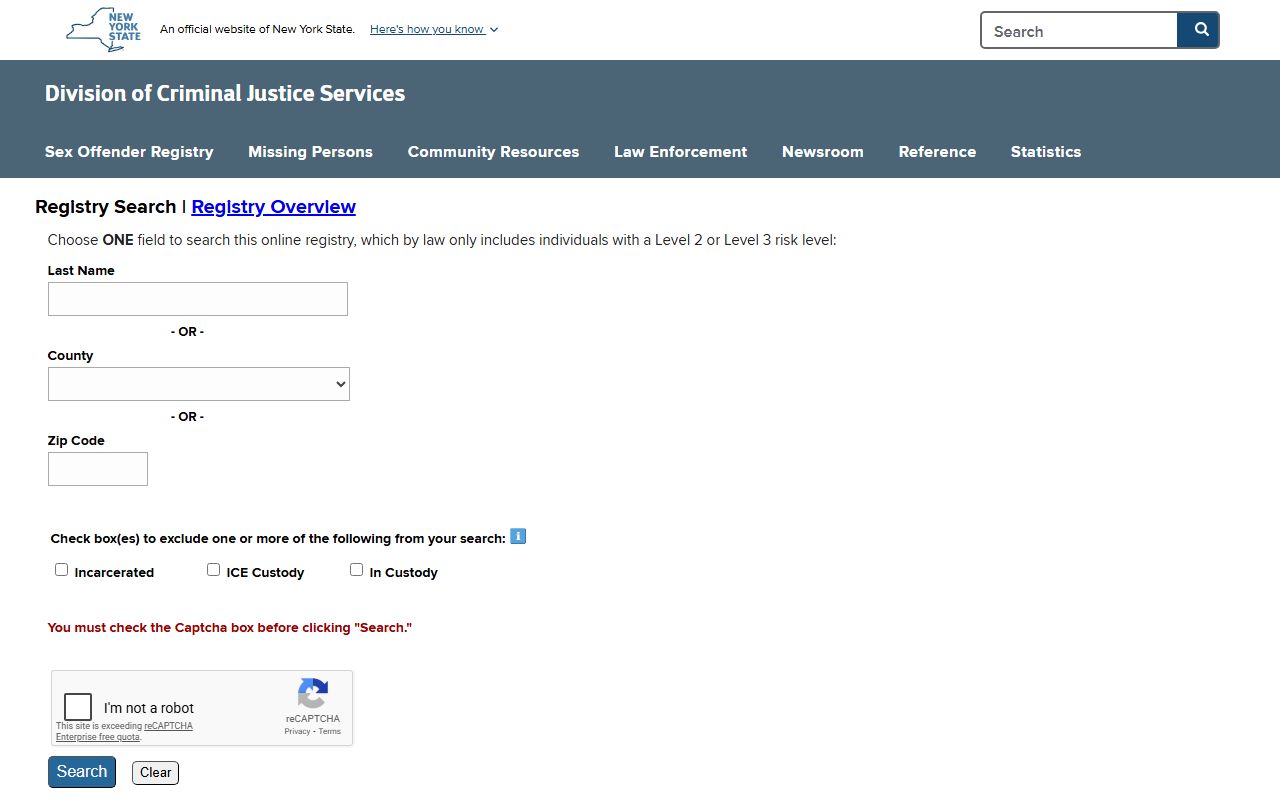
How to Search for Sex Offenders in New York
The New York State Division of Criminal Justice Services maintains an online directory of sex offenders classified as Level 2 or Level 3. This is the main tool for finding sex offenders in New York. The search is free. It runs 24 hours a day. You can look up sex offenders by last name, county, ZIP code, or view all offenders in a given area. The NYS Sex Offender Registry search page gives you photos, addresses, convictions, and vehicle info for each listed offender. Multiple photos are added as they become available, along with any aliases the person uses.
Level 1 sex offenders are not in the online directory. State law keeps them out of the public website. To find out if someone is a Level 1 sex offender, you must call the registry at 1-800-262-3257. Staff are on hand from 8 a.m. to 4 p.m., Monday through Friday. You need the person's name plus one of these: an exact address, date of birth, driver's license number, or Social Security number. The phone line also covers offenders whose risk level has not yet been set by a judge.
There are four ways to get sex offender info in New York. Call the toll-free line. Search the online subdirectory. Contact your local sheriff or police. Or view the subdirectory at a local law enforcement office. Each method gives different levels of detail based on the offender's risk level, as required by Correction Law Article 6-C.
New York Sex Offender Risk Levels
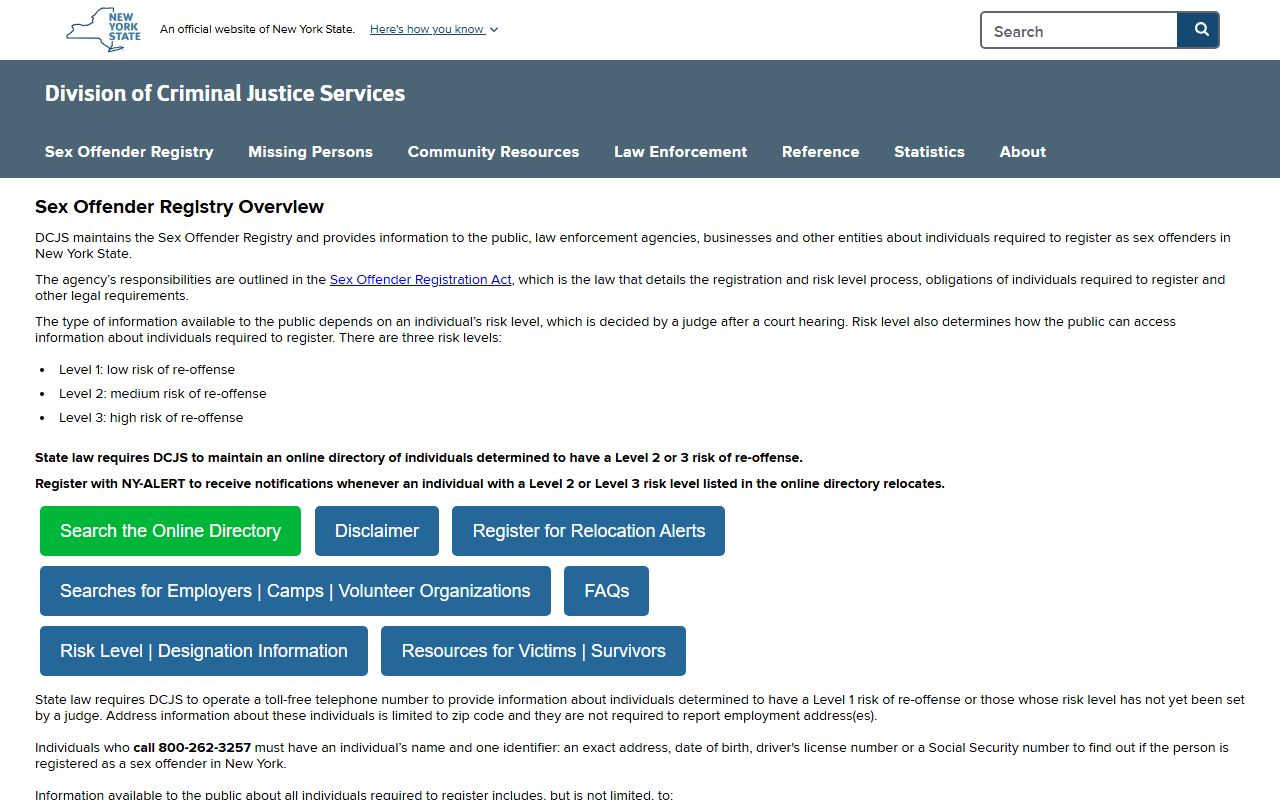
Every sex offender in New York gets a risk level after a court hearing. A judge looks at the facts of the case and scores the offender on things like use of force, victim age, number of victims, and whether drugs or weapons were involved. The result is one of three risk levels. Two sex offenders convicted of the same crime can end up with different risk levels based on the details of their cases.
Level 1 means low risk. These sex offenders must register for 20 years unless they have a special designation. Their address info is limited to ZIP code only. Level 2 means moderate risk. Full address is public. Level 3 means high risk and a threat to public safety. Full address is public, and Level 3 sex offenders must verify their address every 90 days in person with local police. Level 2 and Level 3 sex offenders are listed in the online public subdirectory.
On top of the risk level, a court can also designate a sex offender as a sexual predator, sexually violent offender, or predicate sex offender. Any of these designations means lifetime registration, no matter the risk level. Level 1 sex offenders with no designation register for 20 years. All Level 2 and Level 3 sex offenders register for life.
The Sex Offender Registration Act in New York
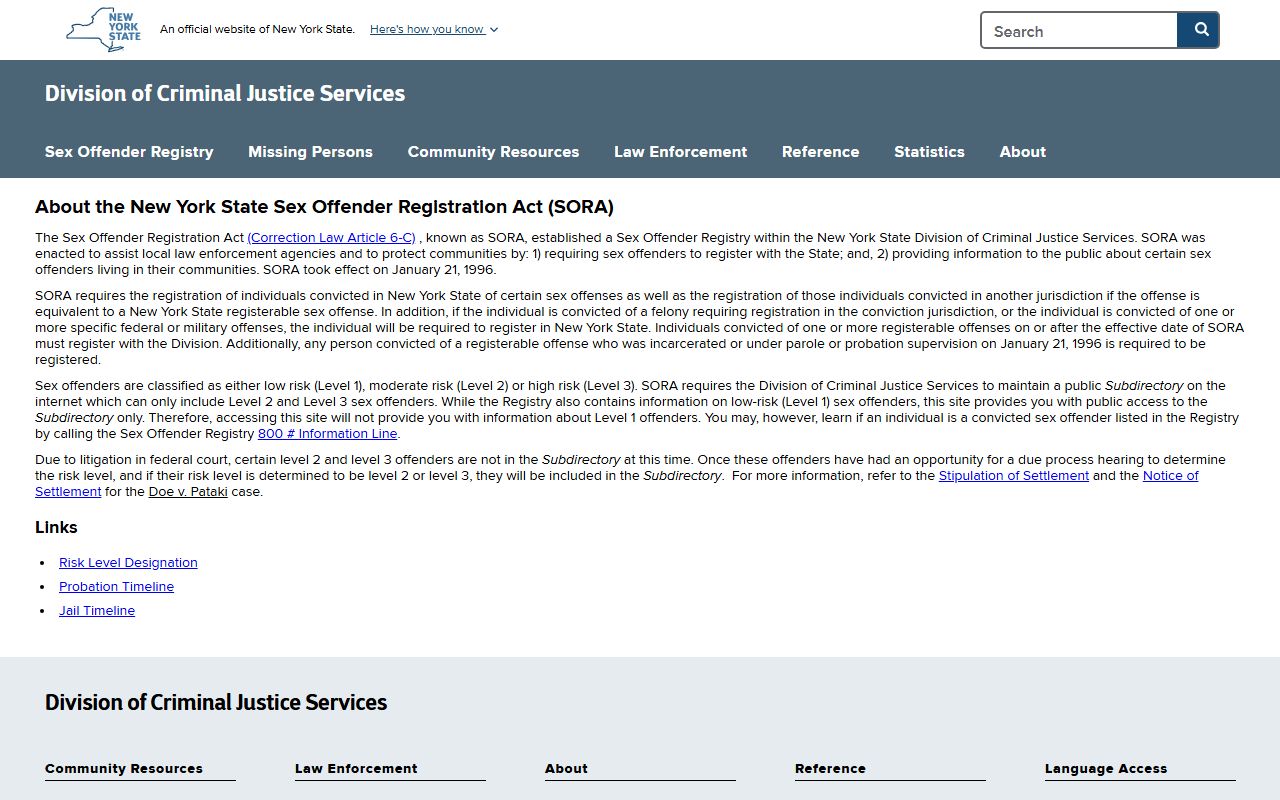
New York's Sex Offender Registration Act, known as SORA, is the law behind the registry. It took effect on January 21, 1996, after Governor George E. Pataki signed it in July 1995. The statute sits in Correction Law Article 6-C, Section 168 et seq. SORA requires sex offenders convicted in New York of certain offenses to register with the state. It also covers people convicted in other states if their offense matches a New York registerable offense. Federal and military convictions can trigger registration too.
SORA has two main goals. First, it requires sex offenders to register so law enforcement can track them. Second, it gives the public access to information about sex offenders in their communities. The law spells out who must register, how risk levels are set, what info is public, and what happens if an offender fails to comply. Under SORA, failure to register or verify address is an E felony for the first offense and a D felony for any later offense.
Chapter 1 of the Laws of 2006 extended registration periods. Before that change, some sex offenders registered for shorter terms. Now, Level 1 sex offenders with no special designation must register for 20 years. Everyone else registers for life. A Level 2 sex offender who has been registered for at least 30 years and has no designation can petition the court for relief under Correction Law Section 168-o.
How Sex Offender Registration Works in New York
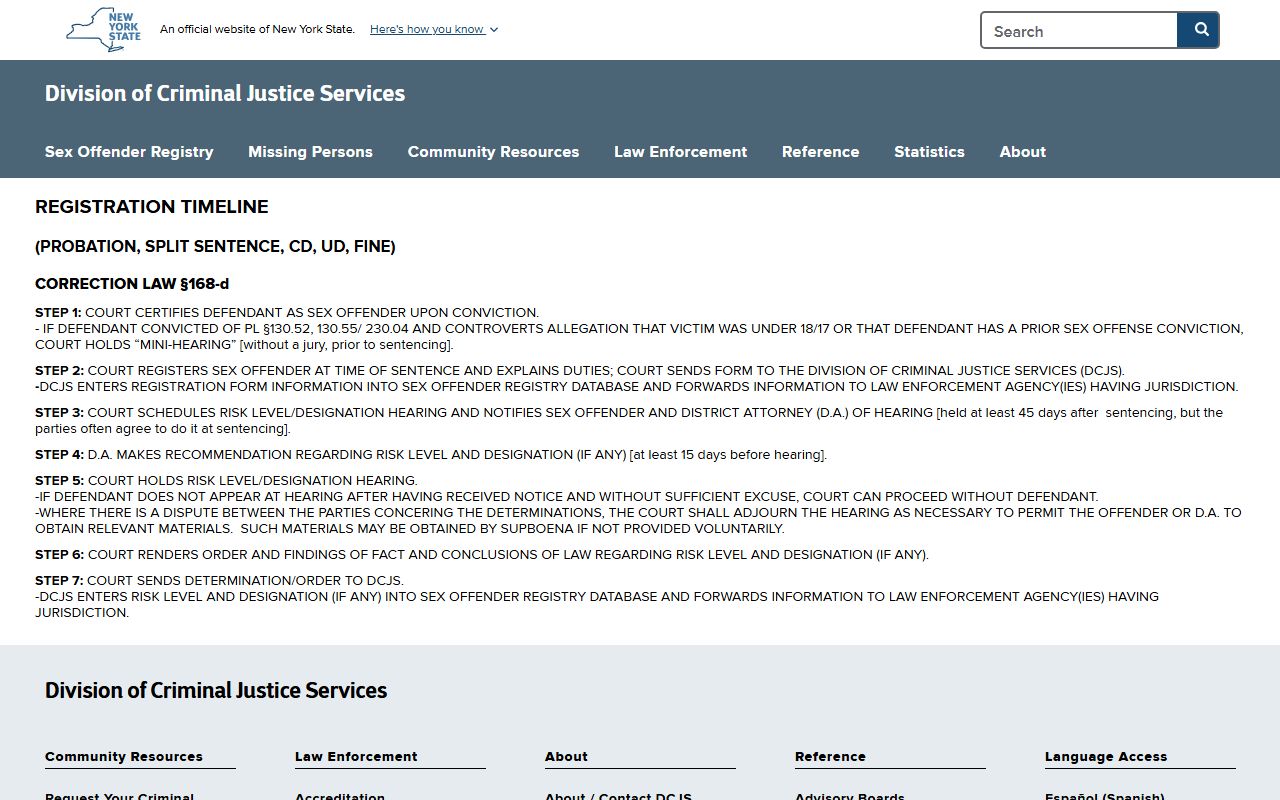
Registration starts at conviction. The court certifies the person as a sex offender and registers them at sentencing. The court sends the form to DCJS, which enters the data into the Sex Offender Registry database. DCJS then forwards the info to whatever law enforcement agency covers the area where the sex offender will live.
For sex offenders going to jail or prison, the process has a longer timeline. The Board of Examiners of Sex Offenders gets notified at least 120 days before release. The Board reviews the case and makes a risk level recommendation to the court 60 days before release. The court holds a hearing, and the judge sets the risk level at least 30 days before the person gets out. The jail or prison registers the offender at least 15 days before release and sends the form to DCJS at least 10 days before. Under Correction Law Section 168-l(8), a missed deadline by any agency does not remove the sex offender's duty to register.
Sex offenders on probation follow a faster track. The court registers them at sentencing. A risk level hearing is set at least 45 days after the sentence, though parties often agree to hold it at sentencing. The District Attorney makes a recommendation at least 15 days before the hearing.
What the New York Sex Offender Registry Shows
The type of info you can get depends on the sex offender's risk level. For all registered sex offenders, the registry holds residence addresses, crimes of conviction, prior offenses requiring registration, multiple photos if available, vehicle make and model with plate number, and any conditions of parole or probation. But not all of this shows up the same way for every level.
For Level 1 sex offenders, the address shown is limited to ZIP code. You can only get their info by phone. For Level 2 sex offenders, the full address is public. Law enforcement can share the offender's photo, exact name, aliases, address, crime of conviction, and mode of operation with entities that serve vulnerable populations. Level 3 sex offenders get the broadest disclosure. Their info is in the online subdirectory, and local law enforcement is required to notify schools, daycare centers, neighborhood watch groups, community centers, places of worship, nursing homes, and other organizations.
Photo updates happen on a set schedule. Level 1 and Level 2 sex offenders must submit new photos every three years. Level 3 sex offenders submit photos every year. If local police notice a change in the offender's appearance, they can take a new photo and send it to the registry.
Sex Offender Internet Rules in New York
The Electronic Security and Targeting of Online Predators Act, added by Chapter 67 of the Laws of 2008, requires all registered sex offenders in New York to report their internet accounts, email addresses, and screen names to DCJS. This includes social networking accounts, chat names, instant messaging handles, and any other online identifiers. Changes must be reported within 10 days. Failure to report internet info is a felony, just like failing to report an address change.
DCJS can share sex offender internet info with social networking sites that have members under 18. Those sites can use the data to remove sex offenders from their platforms or notify law enforcement. The law does not ban sex offenders from using the internet entirely. But sex offenders convicted of crimes against minors, or those who used the internet to commit their offense, face mandatory internet restrictions as a condition of probation, parole, or conditional release. All Level 3 sex offenders under supervision also face these restrictions, regardless of their offense details.
Sex Offender Alerts Through NY-ALERT
DCJS partners with NY-ALERT to let people sign up for free notifications. You can get an alert by email, text, fax, or phone call whenever a Level 2 or Level 3 sex offender moves into or out of a community that matters to you. You pick up to three locations by county, municipality, ZIP code, or specific address. Many people register their home, workplace, and child's school.
This system has been in place since March 15, 2010. You sign up through the NYS Sex Offender Registry website. It only covers sex offenders in the public subdirectory, meaning Level 2 and Level 3. Level 1 sex offenders are not included in the alert system.
Contact the New York Sex Offender Registry
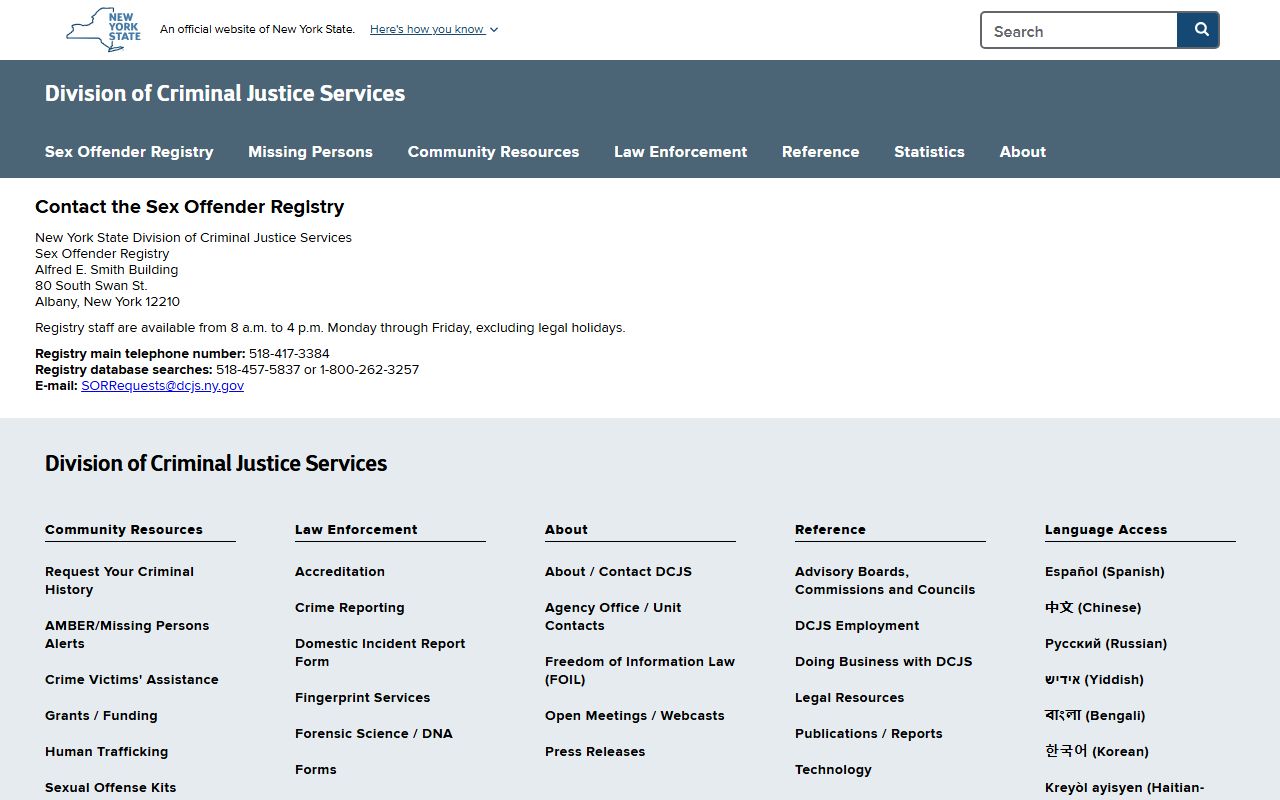
The Sex Offender Registry is housed at the Alfred E. Smith Building, 80 South Swan St., Albany, New York 12210. Staff are available from 8 a.m. to 4 p.m. Monday through Friday, excluding legal holidays.
- Main phone: 518-417-3384
- Registry search requests: 518-457-5837 or 1-800-262-3257
- Email: SORRequests@dcjs.ny.gov
For questions about a specific sex offender's status, the toll-free line is the best option. For general questions about the registry, use the main number or email. The DCJS contact page has the full details. You can also reach the registry FAQ page for common questions about registration duration, risk levels, and compliance rules.
Where Sex Offenders Can Live in New York
SORA does not restrict where sex offenders can live. There are no statewide residency buffer zones around schools or parks for registered sex offenders in general. The New York State Court of Appeals ruled in People v. Diack that local governments cannot create their own sex offender residency restrictions. New York's statutory scheme occupies the entire field of sex offender regulation, so cities and towns cannot add their own rules.
There are some limits. The Sexual Assault Reform Act (SARA) bars certain sex offenders from knowingly entering school grounds or living within 1,000 feet of school grounds when the victim was under 18 or the offender is Level 3. Sex offenders on parole or probation may also have case-specific conditions, like staying away from schools or avoiding unsupervised contact with children. Those conditions are set by parole or probation officers on an individual basis, not by a blanket law.
Browse New York Sex Offenders by County
Each of New York's 62 counties has a sheriff's office or police department that helps monitor sex offenders at the local level. Pick a county below for local contact info and resources.
Sex Offenders in Major New York Cities
Residents of major cities can search for sex offenders through the state registry or by contacting their local police department. Pick a city below to find local resources and contact info.